

Sketsa.id – The Israeli-Palestinian conflict is one of the world’s most enduring and complex issues. Recently, the term “two-state solution” has exploded across social media and news headlines, fueled by Indonesian President Prabowo Subianto’s speech at the United Nations General Assembly on September 22, 2025.
His address not only reaffirmed Indonesia’s support for this framework but also sparked intense global debate, with reactions ranging from praise for its pragmatism to accusations of betrayal. This article breaks down what the two-state solution means, its role in foreign policy, and why President Prabowo’s stance has caused such a viral stir.
What is the Two-State Solution?
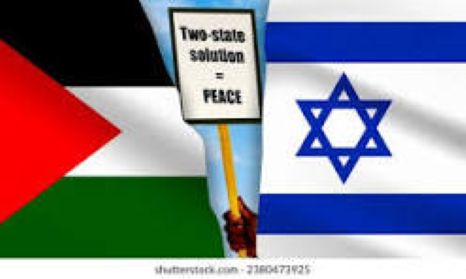
In simple terms, the two-state solution is a proposed peace plan aimed at resolving the Israeli-Palestinian conflict by creating two independent, neighboring states: Israel and Palestine.
The core idea is to divide the land between the Jordan River and the Mediterranean Sea—historically known as Palestine—into two sovereign countries. The proposed borders generally follow the pre-1967 lines (the “Green Line”), with the State of Palestine gaining control of the West Bank, Gaza Strip, and East Jerusalem as its capital. Israel would exist within its pre-1967 borders, with possible agreed-upon land swaps to account for some Israeli settlements.
The concept isn’t new. It dates back to the 1947 UN Partition Plan (Resolution 181). However, it gained modern traction through the 1993 Oslo Accords, which established the Palestinian Authority and laid the foundation for a future Palestinian state.
The two-state solution is officially supported by a majority of the international community, including the United States, the European Union, and many Arab and Muslim nations. It is seen as the most viable path to lasting peace, ensuring security and self-determination for both peoples. However, its implementation has been stalled for decades by major obstacles, including:
- The status of Jerusalem
- Israeli settlements in the West Bank
- The right of return for Palestinian refugees
- Security arrangements for both states
The Two-State Solution in Global Foreign Policy
In international diplomacy, supporting the two-state solution is a common position for countries that want to advocate for peace without overtly antagonizing key allies. It is a cornerstone of numerous United Nations resolutions.
For a country like Indonesia, the world’s largest Muslim-majority nation, this stance is deeply rooted in its foreign policy principles. Indonesia’s constitution explicitly opposes colonialism in all its forms, and the country has a long history of supporting Palestinian independence as a matter of national self-determination.
Why Did It Go Viral? The Prabowo Factor
While the two-state solution is a well-known concept, it surged back into the global conversation due to one key event: President Prabowo Subianto’s speech at the UN.
During his address, Prabowo made a powerful and specific case for the two-state solution, stating, “Only a two-state solution will bring peace, as we must ensure Palestine’s independence.” He went beyond rhetoric by offering concrete steps, including Indonesia’s readiness to contribute peacekeeping troops.
The most controversial and headline-grabbing part of his speech, however, was his indication that Indonesia would be willing to formally recognize Israel—but only if Israel reciprocated by recognizing an independent Palestinian state. This marked a significant shift from Indonesia’s traditionally more ambiguous stance toward Israel and positioned the country as a potential proactive mediator.
The reaction online was immediate and fierce. On platforms like X (formerly Twitter), the speech went viral, splitting public opinion:
- Supporters praised Prabowo for a “realistic” and “pragmatic” approach that could break the deadlock.
- Critics, both in Indonesia and abroad, labeled it a “betrayal” of Indonesia’s long-standing solidarity with the Palestinian cause, arguing it legitimizes the occupation.
The controversy was amplified by a technical glitch that interrupted the live broadcast of both Prabowo’s and Turkish President Recep Tayyip Erdoğan’s speeches. Speculation, fueled by some Turkish media, that this was a deliberate act of sabotage, added a layer of intrigue that further fueled the online fire.
What Does This Mean for Indonesia’s Foreign Policy?
Prabowo’s speech signals a potential evolution in Indonesia’s diplomatic strategy. It suggests a move from principled but cautious support for Palestine toward a more active, solution-oriented role on the world stage. This could enhance Indonesia’s reputation as a significant global player capable of bridging divides.
However, this shift is not without risk. Domestically, it could face strong backlash from segments of the Indonesian public and political groups that view any engagement with Israel as a compromise of core anti-colonial values.
The two-state solution remains the most widely endorsed, yet elusive, framework for peace in the Middle East. Its recent viral resurgence, sparked by President Prabowo’s bold UN address, highlights how sensitive and emotionally charged this issue remains for people around the world. While Prabowo has reignited the conversation, the ultimate question remains: will this new momentum translate into tangible progress, or will it fade as another chapter in the long and difficult search for peace? Only time will tell.