

Teheran, Sketsa.id – Following the joint US-Israeli strike that killed Iran’s Supreme Leader Ayatollah Ali Khamenei on February 28, 2026, Iranian officials and military commanders have signaled strong resolve to respond decisively and sustain a long-term confrontation if necessary.
Rather than relying solely on immediate retaliation, Iran appears to have spent years developing layered defensive and offensive capabilities designed to survive initial strikes and impose significant costs on any adversary over an extended period. Analysts and regional security experts point to several core elements of Teheran’s strategy.
1. Underground “Missile Cities”: Designed to Survive First-Strike Attacks Quantity of missiles matters, but survivability is even more critical in a drawn-out conflict. Iran has invested heavily in a nationwide network of hardened underground tunnels, concealed storage facilities, and protected launch sites—commonly referred to in open-source reporting as “missile cities.”
These dispersed and fortified installations make it extremely difficult for adversaries to destroy Iran’s missile arsenal in a single wave of strikes. Military planners must therefore assume that a meaningful portion of Iran’s ballistic and cruise missile inventory would remain operational even after a major opening salvo, raising the prospect of a prolonged exchange rather than a decisive, short campaign.
2. Strait of Hormuz: Economic Leverage Without Formal Blockade
Iran’s ability to threaten maritime traffic in the Strait of Hormuz—the chokepoint through which roughly one-fifth of global seaborne oil passes—remains one of its most potent asymmetric tools.
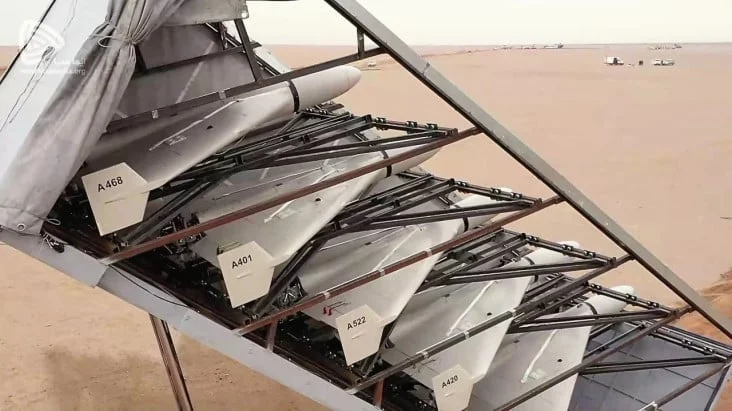
Teheran can disrupt commercial shipping through anti-ship missiles, naval mines, fast-attack craft operated by the Islamic Revolutionary Guard Corps (IRGC) Navy, kamikaze drones, and systems it describes as hypersonic (such as the Fattah series), though independent verification of their full operational status remains limited.
A formal blockade is not required to create market turbulence. Public threats broadcast from IRGC vessels, sharply higher war-risk insurance premiums, and recent attacks on tankers reportedly linked to US and British interests have already prompted major shipping companies to alter routes or pause transits. Danish container giant Maersk announced over the weekend that it was suspending all passages through the strait until further notice.
3. US Forces in the Gulf: Expanded Presence Equals Expanded Targets The recent reinforcement of US naval and air assets across the Gulf region—described by Pentagon officials as one of the largest concentrations of American firepower near Iran in recent years—strengthens Washington’s offensive and defensive options. At the same time, it significantly enlarges the list of potential Iranian targets.
US personnel and equipment are distributed across multiple allied countries, relying on a network of bases, logistics hubs, and command centers that cannot all be protected to the same degree around the clock. Security analysts note that successful strikes against even a subset of these locations could alter political calculations in Washington, exert pressure on regional host governments, and substantially increase the financial and operational cost of sustaining any conflict.
4. Tehran’s Core Message: No “Limited” War Iranian leaders have consistently warned that any direct attack on Iranian soil would be treated as the opening phase of a broader regional war, not a contained operation. Following the death of Supreme Leader Khamenei, that rhetoric has intensified.
The IRGC has pledged sustained retaliation rather than a single high-profile strike. Public statements and state media indicate plans for repeated missile barrages toward Israel, coordinated actions against US-linked facilities across multiple countries, and continued pressure on critical maritime trade routes.
The conflict could also expand through Iran’s network of regional allies, including Hezbollah in Lebanon and the Houthis in Yemen, both of which have condemned Khamenei’s killing and expressed alignment with Teheran’s position.
While the situation remains highly fluid, Iran’s posture suggests a deliberate strategy of deterrence through endurance: absorbing punishment, preserving core capabilities, and imposing escalating economic and military costs on opponents over time. Whether this approach will prevent further escalation or instead prolong and widen the conflict is one of the central questions facing policymakers in the region and beyond. (*)