

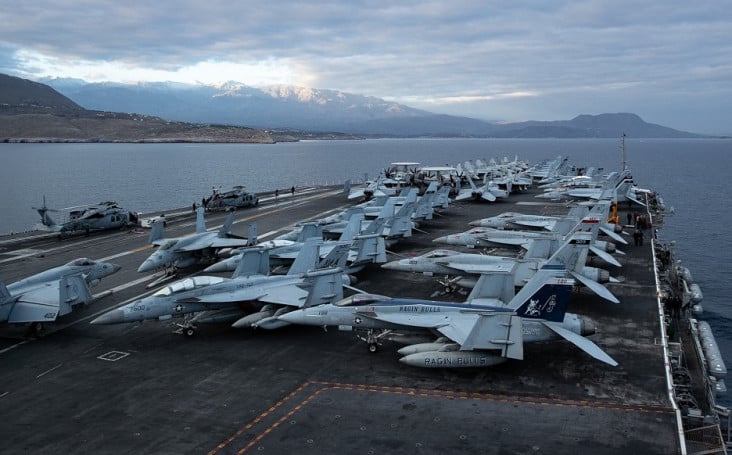
Washington DC, Sketsa.id – The United States has deployed the USS Gerald R. Ford (CVN 78) to the Middle East, joining the USS Abraham Lincoln in a show of naval force amid rising tensions with Iran. Citing US officials, The New York Times confirmed that the carriers were redirected from the Caribbean to the region.
The deployment marks a significant escalation, as both carriers represent the pinnacle of American naval power. But how do the two giants compare? Here are the key differences:
1. USS Gerald R. Ford: The Newest and Most Advanced Nuclear-Powered Carrier
According to Wio News, USS Gerald R. Ford is the US Navy’s newest and most technologically advanced nuclear-powered aircraft carrier. It is the largest warship ever built, representing the peak of American naval engineering. Designed with cutting-edge technology, electromagnetic launch systems, and advanced radar, the Ford is built to project overwhelming air power and global maritime dominance.
2. Wider Flight Deck for Better Operations
Compared to USS Abraham Lincoln, the Gerald R. Ford is slightly heavier, displacing nearly 100,000 long tons at full load, while the Lincoln weighs around 97,000 tons. Both ships stretch 1,092 feet in length with flight decks ranging from 252 to 256 feet wide. However, the Ford’s wider deck and higher hull improve aircraft operations in rough seas, allowing for more efficient takeoffs and landings.
3. More Efficient Power Plant
The Ford is powered by two new A1B reactors, generating 700 MW of thermal power—25 percent more efficient than the A4W reactors on the Lincoln. This allows the Ford to reach speeds exceeding 30 knots with unlimited range. The new reactors also require 25 percent fewer crew members thanks to electric propulsion and automation, reducing operational costs and crew fatigue.
4. Electromagnetic Launch System (EMALS)
One of the Ford’s most significant advantages is its Electromagnetic Aircraft Launch System (EMALS), which replaces the steam catapults used on the Lincoln. EMALS can launch heavier aircraft like the F-35C (weighing up to 31 tons) with greater precision, compared to the Lincoln’s steam catapults which are limited to 30 tons. This technology enables the Ford to launch up to 160 sorties per day—33 percent more than the Lincoln—with peak capacity reaching 270 sorties in surge conditions.
5. Optimized for Unmanned Systems
Both carriers can accommodate 75 to 90 aircraft, including F/A-18s, F-35Cs, EA-18G Growlers, E-2D Hawkeyes, and MH-60 helicopters. However, the Ford is specifically optimized for unmanned aerial vehicles (UAVs) and drones, with a flexible hangar design and dual-band radar that support future unmanned systems. The Lincoln relies on the proven but less adaptable Nimitz-class layout.
6. Superior Radar and Sensor Technology
The Ford is equipped with the AN/SPY-6(V)1 dual-band radar, capable of detecting stealth threats at ranges exceeding 200 nautical miles with 30 times greater sensitivity than the Lincoln’s mix of SPY-1 and SPY-6 systems. The Ford’s integrated Ship Self-Defense System (SSDS) Mk2 is better equipped to handle hypersonic threats and anti-access/area denial (A2/AD) challenges.
7. Crew Efficiency and Cost Savings
With a crew of approximately 4,539 sailors—about 500 fewer than the Lincoln’s 5,000—the Ford relies heavily on automation for weapons handling, damage control, and administrative tasks. This reduction in manpower lowers lifecycle costs by an estimated $4 billion and reduces crew fatigue, allowing for longer deployments with less strain on personnel. (*)