

Jakarta, Sketsa.id – Have you ever wondered why millions of workers across the world take to the streets every May 1st? The answer lies not in an ancient decree, but in the gritty industrial heart of 19th-century Chicago.
In the 1880s, American factory workers faced brutal conditions. Standard shifts often ran 10, 12, or even 16 hours a day, seven days a week. Men, women, and children toiled in dangerous, windowless mills for wages that barely kept them alive. There were no safety regulations, no overtime pay, no weekends, and no right to complain. The working class was treated as disposable cogs in a vast industrial machine.
Against this backdrop of exhaustion and dehumanization, a radical demand began to echo through union halls: “Eight hours for work, eight hours for rest, and eight hours for what we will.“
The labor movement decided to force the issue. The Federation of Organized Trades and Labor Unions set a hard deadline: May 1, 1886. On that day, a general strike would sweep the nation to enforce the eight-hour workday. The response was staggering. An estimated 300,000 to 500,000 workers across the United States walked off the job. In Chicago, the epicenter of the unrest, over 40,000 workers marched peacefully.
That peace was shattered on May 3rd. Police attacked striking workers at the McCormick Harvesting Machine Company, killing at least two. Enraged by the brutality, labor activists called for a mass rally the next day at Haymarket Square.
As police moved in to disperse the crowd, an unknown person hurled a dynamite bomb into the police line. The explosion killed seven officers and wounded dozens more. Police opened fire into the retreating crowd, killing an unknown number of civilians.
The Haymarket Affair became a national panic. In the ensuing trial, widely condemned as a miscarriage of justice, eight labor activists were convicted of conspiracy despite weak evidence linking them to the bombing. Four were hanged, and one committed suicide in his cell.
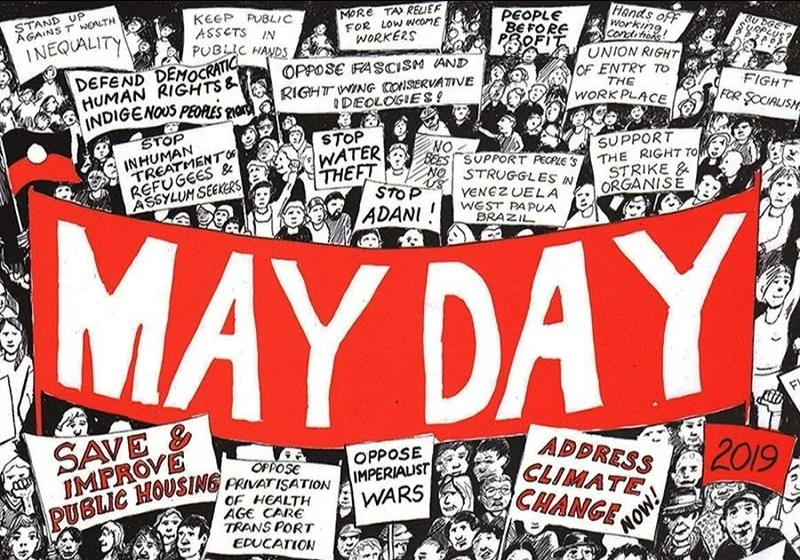
Three years later, in 1889, the International Socialist Congress convened in Paris. To honor the martyrs of Chicago who gave their lives fighting for the eight-hour day, the congress declared May 1st as International Workers’ Day. From that moment on, the date became an annual rallying point for workers worldwide.
Ironically, the United States, where the struggle began, does not officially celebrate May Day due to its association with anarchists and the communist movement. Instead, Americans celebrate Labor Day in September.
But the irony remains: every worker in the world who enjoys a weekend, a paid sick day, or the right to leave work after 5 PM owes a silent debt of gratitude to the brave, exhausted martyrs of Chicago who dared to demand that life should be about more than endless toil. (cc)